Paper: Object Detection with Adaptive Annotation Styles in Ultrasound Videos via Teacher–Student Learning
Object Detection with Adaptive Annotation Styles in Ultrasound Videos via Teacher–Student Learning
Hyeon Woo Lee1*, Li Chen1* ✉, Rashid Al Mukaddim1, Naveen Balaraju1, Stephen Schmidt1, Mohsen Zahiri1, Shubham Patil1, Nikolai Schnittke2, Bryson Hicks2, David O. Kessler3, Maria Parker2, Aaron Silver2, Kenton W. Gregory2, Cynthia R. Gregory2, Jochen Kruecker1, Goutam Ghoshal1, Alvin Chen1†, Balasundar Raju1†
1Philips Ultrasound, Philips North America, Cambridge, MA, USA
2Oregon Health & Science University, Portland, USA
3Columbia University Medical Center, New York, NY, USA
*†Equal Contribution
✉ Corresponding author. Address: 222 Jacobs Street, Cambridge, MA, 02141. Email address: li.chen_1@philips.com
Abstract
Objective: To develop a teacher–student learning framework that mitigates the adverse effects of heterogeneous annotation conventions in ultrasound video object detection and supports reuse of retrospectively collected datasets without complete re-annotation.
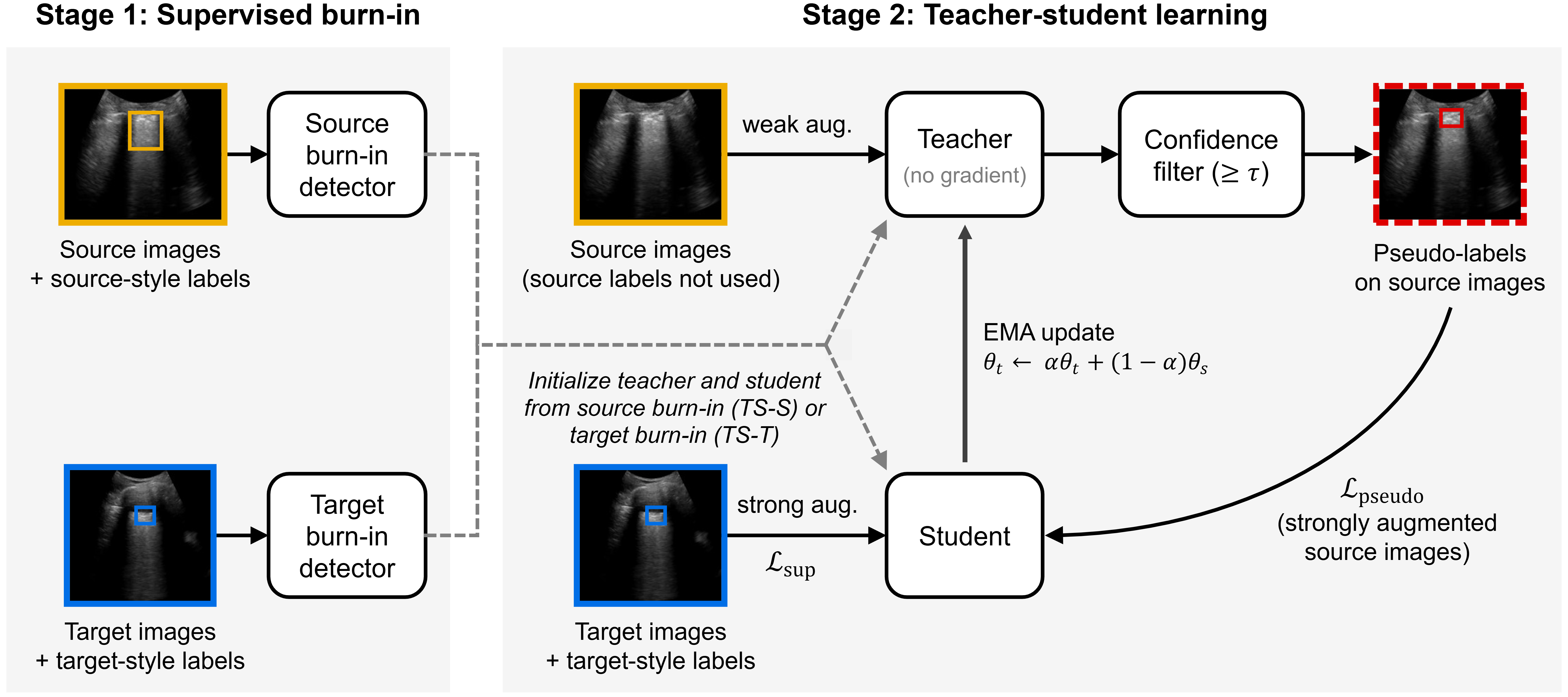
Methods: We formulate annotation style inconsistency as a label-space adaptation problem. A detector is initialized on a small target dataset defining the desired annotation style, and then jointly trained with a teacher model updated by exponential moving average. The teacher generates confidence-filtered pseudo-labels for the larger source dataset, while the student learns from both target-style ground truth and source pseudo-labels. The framework was compared with four baselines (source-only, target-only, combined source+target, and source-to-target fine-tuning) using five-fold, subject-level cross-validation on abdominal anatomy detection and lung consolidation detection tasks.
Results: For abdominal anatomy detection, the proposed method achieved the highest average precision (AP@0.5). It significantly outperformed three of the four baselines, but its advantage over the best baseline, source-to-target fine-tuning, was not statistically significant (0.379 versus 0.321; adjusted p = 0.094). For lung consolidation detection, the proposed method achieved significantly higher AP@0.5 than all four baselines, including the best baseline, target-only training (0.282 versus 0.137; adjusted p < 0.001).
Conclusion: Target-style supervision can guide teacher-generated pseudo-labels toward a desired annotation convention, allowing heterogeneous source data to be reused without re-annotation. The improvement was smaller for abdominal anatomy detection but significant for lung consolidation detection. Within the evaluated settings, the results support teacher–student learning as a promising approach to object detection under annotation-style mismatch.
Accepted by Ultrasound in Medicine & Biology
Popular articles
- 1 Fully automated and Robust Analysis Technique for Popliteal Artery Vessel Wall Evaluation (FRAPPE)
- 2 Paper: Automated Intracranial Artery Labeling using a Graph Neural Network and Hierarchical Refinement
- 3 Blood pressure measurement system using NI myDAQ
- 4 LATTE on 3D-MERGE
- 5 About Personal website