Paper: Graph-Based Pseudo-Label Selection for Weakly Semi-Supervised Object Detection in Ultrasound Videos
Graph-Based Pseudo-Label Selection for Weakly Semi-Supervised Object Detection in Ultrasound Videos
Li Chen; Jiahong Ouyang; Naveen Balaraju; Balasundar Raju; Jochen Kruecker; Alvin Chen
Abstract:
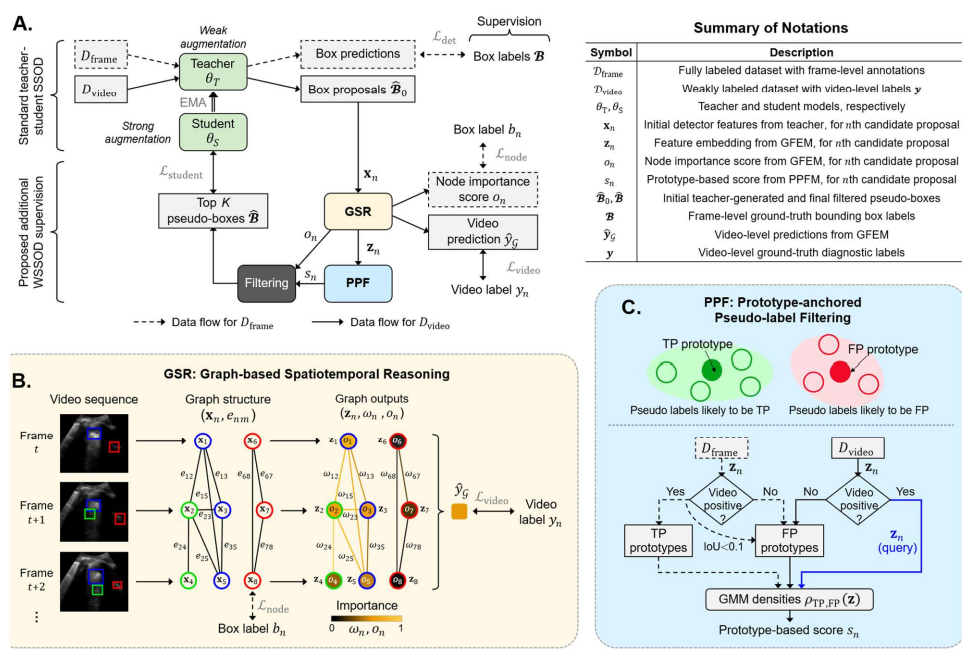
Training object detectors for medical ultrasound videos requires dense frame-by-frame annotations by experts, motivating the use of less costly video-level labels within a weakly semi-supervised object detection (WSSOD) framework. Existing teacher-student approaches typically rely on confidence-based filtering or heuristic spatio-temporal aggregation, which do not provide a principled mechanism for translating global video-level supervision into instance-level pseudo-labels, leading to confirmation bias and error accumulation. We introduce a WSSOD framework that formulates pseudo-label generation as a structured quality assessment problem. Specifically, we explicitly model the relationship between global video labels and local candidate proposals through a graph-based spatiotemporal representation, enabling evaluation of each candidate via long-range relational dependencies. In parallel, candidate proposals are assessed in feature space by measuring their consistency with representations of true-positive and false-positive pathology patterns. By selecting pseudo-labels that are supported by both spatiotemporal context and feature space distributions, the proposed framework effectively translates coarse video-level supervision into reliable instance-level training signals. Experiments on two clinical ultrasound video datasets demonstrate clear quantitative gains over existing SSOD and WSSOD methods using only 10% of frame-level box annotations. On a breast tumor dataset, the proposed method improves over the strongest SSOD baseline by 48% and over the prior WSSOD method by 42%, while recovering 90% of fully supervised performance. On a lung consolidation dataset, the method exceeds the best SSOD and WSSOD baselines by 30% and 17%, respectively, while recovering 75% of fully supervised performance.
Keywords: Object detection, pseudo-labeling, semisupervised learning, ultrasound imaging, weakly supervised learning.
https://ieeexplore.ieee.org/document/11770160
Popular articles
- 1 Fully automated and Robust Analysis Technique for Popliteal Artery Vessel Wall Evaluation (FRAPPE)
- 2 Paper: Automated Intracranial Artery Labeling using a Graph Neural Network and Hierarchical Refinement
- 3 Blood pressure measurement system using NI myDAQ
- 4 LATTE on 3D-MERGE
- 5 About Personal website